Snowbirding Again, At Last

Friday 26 January 2024. Yucatan, Mexico.

I know, it’s been a while!

There was a time, not all that long ago, that we regularly headed off somewhere hot and birdy in January. When we lived in Quebec, it was a relatively easy thing to hop on a plane and head south, normally to somewhere in Central America, for a snow-free week and lots of birds. It had become a less-easy thing since moving to Nova Scotia but we still managed the odd taste of somewhere exotic.

We visited Costa Rica in December of 2019, enjoying two splendid weeks, but the world headed into viral disaster shortly afterwards curtailing any more ‘snowbirding’. We waited until 2023 to get back on a plane, flying to Alberta and enjoying the change of scenery. Now, we thought, it was time to head abroad.

I wasn’t overly excited when Mark suggested revisiting the Yucatán, in Mexico. We’d spent a week there in June 2009, which had been fun but, from what I remembered, not ever so birdy. We had managed to visit quite a few Maya sites and so was probably rather distracted by the ‘piles of rock’ as Mark usually refers to these things. Still, I thought that the ‘Bang for the Buck’, or ‘Tick for the Dollar’ ratio wasn’t going to be high. Mind you, the thought of heading off somewhere, anywhere, in January was tempting, so when he found a ‘Black Friday’ sale all-inclusive trip, I was happy to go along with it. I reckoned I’d get into it once we were there.

It was a fairly early flight so we needed to be at the airport, some three hours drive away from home, at around 6 am. We took advantage of the airport hotel with the one week’s free parking and the shuttle to the airport. Unlike our last foreign trip, the plane was on time and was direct to Cancún, so no chance of missing it. Unfortunately it was the worse of cattle class, Air Canada Rouge, so no food, minimal drinks and no in-flight entertainment, unless you have your own, fully-charged tablet and their app (don’t expect to be able to keep your tablet or phone charged, either!). Still, I like reading so I was ok.

Did I say ‘minimal drinks’? Well, only if you don’t want to pay for it. If you are happy to use your flexible friend to the max then you can drink all flight, and the three people behind us proceeded to do so, ordering round after round and getting louder and louder during the flight. This was an early morning flight, mind you. In the end they were refused any more alcohol by the Flight Attendants, otherwise they’d have had to be poured off the plane when we landed. We really hoped they weren’t going to our hotel.

Getting through Immigration was quite efficient, for those of us who read the instructions on the big screens in the Immigration Hall. There were automated booths that scanned passports, took photos and issued a receipt that absolutely had to remain with the passports and be handed in on departure-on pain of not being allowed out (shame!). It took just a little longer than was comfortable to stand waiting for the photos to be done, leading to people trying to move before it was ready, having to start the whole procedure again, etc., etc. Read the screens, guys!

Outside Cancún Airport

Our cases were, remarkably, quite early off the carousel and we headed for the exits, being bombarded by people offering taxis, timeshares, possibly their sisters, I don’t know. Head down, ignore them all, and pretend not to understand English or cries of ‘Señor, señora’ until we got outside and started to look for the Air Canada Vacations rep. He, bless him, didn’t seem to have our names on his list but a quick phone call sorted that, so we headed off to the coach he indicated and boarded it, waiting for our fellow escapees and enjoying the chaos outside. It was organized chaos, though.

Transfer Bus

Now we had debated getting a hire car at the airport and avoiding the transfer coaches but thought we’d save a day or two’s rental and get one when we got to the resort. In hindsight, we should have done so, and would have, if we’d realised that the estimated 80-90 minute transfer time was actually going to be more like 3 hours, plus waiting time at the airport. Hindsight is truly a wonderful thing.

So we watched out of the windows, enjoying a Great-tailed Grackle and Tropical Mockingbird, along with some Rock Pigeons. The list had started.

People gradually filed on the bus, then got off again to go smoke or go buy cans of beer. Eventually we seemed to be all present and the rep on the coach put paid to the beer-buying trips by announcing that he was selling cans of beer at $5 US a pop! He was kept busy supplying our fellow passengers during the trip, some of whom easily dropped $25-30 US per person just during the transfer. Interestingly, there were no non-alcoholic or water options available, clearly he knew his audience.

Well, we saw quite a few of the other hotels on the coastal strip as ours was fairly close to Tulum and thus furthest from the airport. We even drove past the entrance to the hotel we’d stayed at last time, the Catalonia Royal Tulum. We were quite pleased to find that it was still in business, no sure thing on the Riviera Maya where they seem to be renamed, rebuilt or even left to rack and ruin quite regularly. Eventually, and much later than we’d anticipated, we turned off the coastal highway, under a huge, imposing arch and entered the grounds of the Bahia Principe Luxury Sian Ka’an, a hotel with a large golf course, country club and lots of areas of gated condos, but no beach. That was across the road and attached to the other three hotels in the same group. As guests at the Sian Ka’an, we could have access to the facilities at any of the other hotels in the group (apparently not necessarily the case for people at the other hotels). We’ve always been the exclusive types.

Bahia Principe Luxury Sian Ka’an Hotel Lobby

We checked in, well Mark did. He has a way with that sort of thing, dismissing the clerk’s spiel about beaches, discos, towels for the pool (we hadn’t even packed swimming costumes) and restaurants with a brisk ‘don’t need that, move on’. Actually, he had the clerks in stitches, they were clearly not used to dealing with ‘the birder who knows what he wants’! Once they’d stopped laughing, we got our room keys and some fancy black wristbands that looked like they were made of velvet, and a nice guy with a golf buggy took us to our room. As requested, it was on the top floor and overlooked the vegetation surrounding the hotel. We hadn’t anticipated four flights of concrete stairs with no handrails (neither of us are spring chickens, and Mark has dodgy knees), or a large tree obscuring most of the view from the balcony. Neither had we known about the huge railway construction ongoing at the back of the hotel. We couldn’t see it but we could certainly hear it; constant clanging, banging, beeping, etc. carried on relentlessly from very early morning to unfeasibly late at night.

The room was good, called a ‘junior suite’, which seems to mean that there was a small sitting area as well as a bed and a bathroom. As it was an all-inclusive resort, the mini-bar was well-stocked and free for use. Lots of bottled water was provided and a coffee maker, and bags of crisps (chips). I thought we’d be comfortable enough here, and made quick work of unpacking and settling in. Mark made quick work of settling in on the balcony to look for birds. We only had a short time before sunset, so heading out anywhere wouldn’t be sensible.

Hooded Warbler

Magnolia Warbler

A repeated monotonous call was soon identified as Hooded Warbler-we don’t get many in Nova Scotia so it took a minute of two to get our heads round that. It was splendid male in full plumage, actively feeding in ‘our’ tree and was to be a welcome sight every day of our vacation. It was joined by a Magnolia Warbler, Ruby-throated and Rufous-tailed Hummingbirds, Tropical Kingbird and Vaux’s Swift. A couple of Plain Chachalacas snuggled into the foliage as the light faded. It was a smallish list but we had all week to improve on that.

Plain Chachalaca

Our all-inclusive deal included the option to eat at the hotel complex’s a la carte restaurants, but we are not that foodie and could never be bothered to go book. Anyway, the nearest one was Japanese and I’m not that fond of raw fish. So we decided we’d be happy enough with the main buffet restaurant; that way we’d never be tied down to eating at a specific time. As the light faded, we bathed and dressed for dinner-it sounds a bit ‘Downton Abbey’ but we don’t like submitting our fellow guests to ‘sweaty birder’ over meals- and made our way down the treacherous stairs and over to the lobby, enjoying the bats flying around the complex. There were small ones and big ones, and they made a point of flying through the lobby area, which was wide open at both ends. We thought they were fun, not sure everyone else agreed. Unfortunately we never found out what species they were.

Hotel Buffet

Dinner was ok. They apparently had a theme each night but we didn’t cotton on to that until half-way through the week. It might have been Mexican, but that’s just a guess. We toasted the start of our holiday with a beer and a glass of white wine and then escaped back to our room before the mariachi band had really got going. An early night was on the cards, since we were going to be up before dawn the next morning. Mariachi bands, construction work and air-con noises allowing, of course.


Tutbury

Sunday 08 September 2002. UK.

A trip back in time, prompted by finding a file of photos on my computer. This dates back to my first digital camera and me trying to get used to it before we headed off for our first Egypt holiday. There was a learning curve, and I clearly still wasn’t used to the ability to take as many photos as the card would hold-I was still running on the assumption of 24- or 36- frame film that would cost money to be developed!

Anyway, I’m really not sure how we ended up at Tutbury Castle that day. Admittedly it wasn’t too far south of our then home in Nottingham and I had never visited. I was (am!) the history buff, always interested in castles and other ‘piles of rock’, or ‘footings’, as Mark would term them. He had little interest in that sort of thing. Also it was a weekend day and his job at the time, Warden at a Country Park, tended to mean working all weekend in the summer. Maybe September had eased into the winter schedule when he’d get one day off? At this point I can’t remember but I should be grateful that Mark was willing to spend a precious free weekend day at a ‘pile of rock’. I wonder if there had been a rare-ish bird in the vicinity?

The North Tower at Tutbury

My main interest in the castle was that it was one of the prisons used for Mary, Queen of Scots, who spent four periods living at the castle, beginning in February 1569 and culminating in a visit of about 1 year duration in 1585. From here she went to Chartley and from there to Fotheringay, where she was executed on 08 February 1587, for plotting against Elizabeth I. Mary reputedly hated Tutbury, in particular, complaining of it being old, with wet plaster and draughty, ill-fitting old carpentry. Clearly this would be worth a look for a history fan.

The remaining castle (and it is largely ruined) is mainly 15th and 16th century in date, but the first castle was built around 1071 as a classic Norman motte and bailey. It belonged at that time to the Earls of Derby, and had the misfortune of being repeatedly ‘slighted’ (i.e. partially- or fully-demolished) and then rebuilt, due to successive rebellions of the Earls of Derby against the crown. After the last of these episodes, the ownership of the castle and lands were transferred to the Earls (later Dukes) of Lancaster and remained so; in fact the castle still belongs to the present duke, who happens to be King Charles III.

The castle underwent a number of rebuilds by the Lancastrian family, including John of Gaunt, who seems to have been responsible for the gatehouse. Well, it is known as ‘John o’Gaunt’s Gateway’, so that’s maybe a clue! The castle became the principal residence for his wife, Constance, who formed a court there, thronged with musicians and artists.

John o’Gaunt’s Gateway, from outside.
…and from inside.

After the high point of John of Gaunt’s time, the castle declined and so it was in quite poor condition by the time that Queen Elizabeth was looking for somewhere to lodge her unfortunate, but frankly annoying cousin, Mary. As a figurehead for catholic resistance to Elizabeth’s reign, Mary couldn’t be held too close to London or anywhere close to the Scottish border. The north of England tended to be a holdout for the old religion so Lancashire, Yorkshire and Northumberland were to be avoided. Houses in the midlands were the best option, so Mary’s long period of captivity was undertaken at a number of houses and castles in the East Midlands, of which Tutbury was one. Tudor noble households tended to stay in one place for only a short time, as the limited sanitation of the time meant that the houses tended to get dirty rather quickly. The household would then move out to another property whilst the first house was cleaned and fumigated. Mary’s last stay in the castle was an unusually long one, nearly a year, and she had complained about the state of cleanliness before she was finally moved in December 1585.

The North Tower
The South Tower

The castle continued to decline after Mary’s death, although her son, James (I of England, VI of Scotland) stayed there several times after his accession to the English throne. I wonder if he ever thought about his old mum mouldering away in here?

The castle had a late blossoming when it was refortified during the English Civil War, when it was in Royalist hands. An unsuccessful Parliamentarian siege was followed a year later by another. After three weeks of this second siege, the castle surrendered and it was subsequently slighted by order of parliament, ending its use as a defensive building.

Typical square-topped Tudor windows.
A Tudor fireplace hovers in mid-air. Did Mary, Queen of Scots sit in front of this fire trying to fight off the draughts?
The bailey. The red-brick building to the right is the ‘King’s Lodging’.

There was some occupation continuing on the site, as evidenced by the so-called ‘King’s Lodging’, which is still intact, and that a folly was build on the motte in 1780. There was a fashion at that time for romantic ruins, as if the castle ruins weren’t already romantic enough, and so a ‘ruined keep’ was constructed on the mound where the original Norman keep would have been.

Julius’s Tower, the folly on the motte.
Julius’s Tower

I have always enjoyed clambering around a ruined castle, up and down the spiral staircases and looking out from the battlements.

I left Mark down in the bailey and went for an explore. It seems that the castle served as a barracks during the Napoleonic Wars and afterwards, as there were interesting graffiti on some of the walls (along with less interesting modern stuff).

It looks like Mr. Crichton had plenty of time on his hands back in 1818, and that he was proud of being a Freemason. Henry Smith wasn’t quite so empathic in 1794.

Two generations of Cowenlocks seem to have been present, in 1829 and 1856.

What is it with the human desire to make their mark on history?

A local re-enactment group were drilling in the bailey. It looked like a mixture of uniforms, mainly Victorian, but added a bit of colour to the proceedings.

So that was Tutbury. Not a huge amount to see but I thought it definitely worth a visit. Nowadays it is a rather slick place if you look at the website, which you can hire for weddings or wakes, so I’m rather pleased I saw it when that side of things was less developed-although that large marquee in the background of the photo above suggests that it was already an option, even then.

It’s a bull. I must have just been impressed by the horns!

Clam Point

Monday 11 September 2023. Nova Scotia.

One of the things we love about living in Nova Scotia is the proximity of the sea. It has its downsides of course, such as the frequent (especially this year!) sea fogs in the summer and the fun of the autumn hurricane season (I’m writing this as Post-tropical Storm Lee is due to come ashore, pretty much right where we are-I’m astonished we still have power!). Still, it is a beautiful place to live. and sometimes I don’t make the most of it.

A case in point is Clam Point. It’s the name of where we live, and also of a finger of land that pushes out into Barrington Bay. There’s a trail of around 1.5 km length that heads to the end of the point and its a pleasant walk, so why have I only walked it twice in 8+ years? I don’t know, but this Monday afternoon we decided to give it a go. The reason was that Mark had seen a couple of Leach’s Storm-Petrels out in the channel, a new bird for our yard list, and he wanted a closer look. We drove round to the little rough parking area and headed off along the trail.

Clam Point in the distance
Gulls and Cormorants loafing on the rocks

The trail edges the bay, with a small area of woodland on the other side, dotted with ponds. A couple of ducks were trying (and failing) to be inconspicuous.

Mallards on the pond

Further along the track the woodlot gives way to saltmarsh, the same saltmarsh that can be seen from our front window, and whish provides us with habitat for quite a lot of our ‘yard’ birds! W found some lingering Nelson’s Sparrows here, along with a migrating Bobolink, which refused to sit still and allow photographs.

Clam Point gets closer, as does the fog bank in the channel!
Across Barrington Bay, Villagedale in the distance.
The Saltmarsh
The old homestead (with the blue roof), seen at a distance from the Clam Point trail

There were a couple of late-flying dragonflies. One was the expected Cherry-faced Meadowhawk, the other was a very late male Seaside Dragonlet. I do like the name ‘dragonlet’, only one of a number of evocative monikers that the odonata carry (‘dragonhunter’, anyone?).

Seaside Dragonlet
Clam Point trail

That little area of woodland at the end of the track really marks the position of Clam Point. just behind is a small, white sand beach, very deserted, and a little pile of rocks on the very end. We made our way onto the beacjh and mark set up his scope to look for the petrels. I took a walk along the beach to the rock pile. The last time I’d been there we’d found a small flock of Purple Sandpipers on these rocks, out of season in May. I didn’t really think they would still be there, but you never know your luck!

The beach at the end of Clam Point
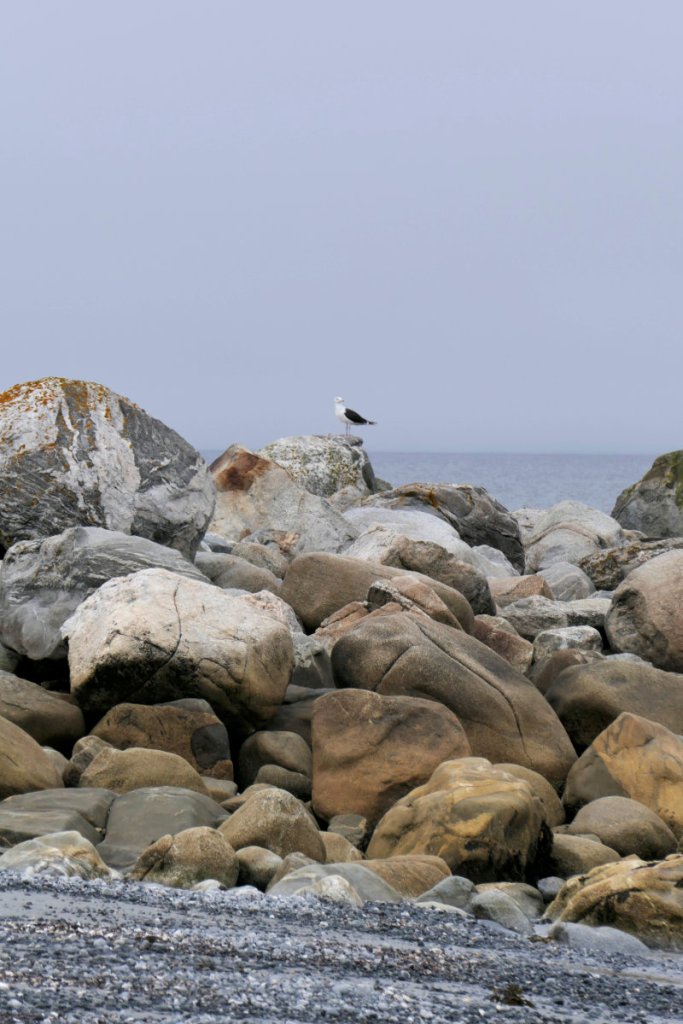
The rocks, no Purple Sandpipers, just a lone Great Black-backed Gull.

There were lots of big shells washed up on the beach and I took the opportunity to collect a handful of the nicer ones. That lower shell was almost as big as my closed fist!

Mark was having no luck with the petrels, and the fog was definitely heading in. Time, then, to head back.

Heading Back

We caught up again with the Bobolink (still no photos) and enjoyed a Harbour Seal, hauled out onto a rock and doing his/her best to sunbathe in the mist. A Common Yellowthroat was the only warbler that showed-but then these are normally the ones that show best in autumn migration round here.

Common Yellowthroat
Harbour Seal

It wasn’t too late in the afternoon, but the sea fog was making everything decidedly murky. It made sense to get home before the light deteriorated further.

Back at the parking area, I stepped over to take a photo of the wharf here. It isn’t lobster season here, that starts in late November, so it was quiet.

A last bird, a Savannah Sparrow, posed briefly by the track. I really should take this walk more often!

Savannah Sparrow

I started writing this post on Saturday morning, 16 September, as Hurricane Lee (or more correctly Post-Tropical Storm Lee) was barrelling towards us. The winds and rain had started the evening before and I was quite surprised that we still had power. The storm had not yet made landfall, at one time it was slated to land directly on us, at other times it was predicted to be Yarmouth, just down the road. In the event it landed further west, over St. Mary’s Bay and Long Island. We however, had already lost power and would be without it for 24 hours-never much fun when everything runs on electricity, including the water pump for the well. Still, the damage caused by Lee seems to have been minimal, so not complaining.

Dippidy-doo-day

Monday 04 September 2023. Nova Scotia and Prince Edward Island

Well, that was unexpected!

There had been a Crested Caracara on Prince Edward Island for quite a while, and we’d even discussed the possibility of going to see it. It would be a Canada tick, after all, although we have seen many individuals of this species when on vacation further south. Still, Canada lists are precious, and Mark is only a couple of species off his 450, so the urge was there. What was stopping us?

Well, mainly it was that the bird had not been pinned down-not literally, that would be cruel – but not being reliably seen in a particular area. After all, if you are going that sort of distance, you want a fair go. Mainly this was due to there being only a limited number of birders on P.E.I.-after all, once you’ve seen the bird then there is little incentive to go back to search for it again (except, perhaps, for ‘month ticks’). Perhaps the new month was the reason why the bird suddenly started being reported again, and for 3 days in the same spot, a blueberry field at Mount Vernon. Three days of confirmed sightings, and some splendid photographs, galvanised Mark to book the ferry for the next morning. We were going to Prince Edward Island for the afternoon!

This was a province that we had never visited, so that would be interesting. There is a bridge that links the island with New Brunswick, but that would add a couple of hours driving to our itinerary (each way) and the bridgehead was a considerable distance up the island from where we needed to be. Conversely, the ferry from near Pictou would get us to within 5 minutes drive of the site of the bird, so that worked better. Sandwiches were made, an emergency overnight bag packed and alarms were set for 4 am. We would be leaving home at 4.30 am in order to catch the 10.15 am ferry.

The next morning (early!) was foggy-oh no, that wasn’t good. Still, we made coffee, fed the cat (and promised her faithfully that we’d be back later that night -well, that was our intention!) and set off. At least the roads were quiet, a combination of early morning and Labour Day saw to that.

Early morning mist over Mount Thom
Highway 104 is not improved by these conditions!

As the sun got higher in the sky, the fog began to burn off, and it was fairly clear, if a bit dull, when we reached the ferry terminal at the evocatively-named Caribou, early for our trip. No problem, we headed off to a nearby provincial park, Caribou Munroe’s Island, for a leg stretch and a bit of birding.

We found a few nice fall warblers, enjoyed a view of Northumberland Strait and Pictou Island from the long beach of red sand and then returned to the ferry port to wait for embarkation.

Magnolia Warbler
The beach at Caribou Munroe’s Island Provincial Park

You have to be at the port for 40 minutes before embarkation, so it provided a chance for breakfast, whilst waiting in the lines.

Belted Kingfisher at the port
Heading on board

They were pretty efficient at emptying off the previous passengers and getting us loaded, there wasn’t much time lost between the boat arriving and leaving again. As it is a ro-ro ferry, with a 75 minute passage time, we were not allowed to stay in the car, so we made our painful way up to the main passenger deck (those stairs are steep, and we are no longer spring chickens!) and found a perch outside, at the front. It was, after all, a sea crossing and you never know! The boat headed off on time, and we settled in for a bit of sea-watching.

The ferry wharf at Caribou
Double-crested Cormorants on the wharf

A couple of Caspian Terns had been reported from the ferry terminal on the night before, so of course we kept our eyes peeled for them, but no luck. In general, birds were pretty scarce, with Double-crested Cormorants and Northern Gannets being the most common species seen.

We sailed out past Caribou Island and the picturesque Caribou Island Light.

Caribou Island Light

Oddly, a birding friend was actually on Caribou Island, looking for Caspian Terns, and saw us on the ferry as we went past! He guessed why we were going….

Although the birding in the Northumberland Strait was quiet-it doesn’t ever seen to be busy there, to be honest-the 75 minutes passed quite quickly. Feeding gannets were fun to see, and a lone lobster boat quite near the shipping lane gave us something to look at, too.

The sister ship, ‘Confederation’, heading back to Nova Scotia

We were heading to Woods Islands, and we could see the Front Range Light on the shore. It was time to return to the car, via the precipitous stairway, and wait to be disgorged onto PEI. It was 11.30 am and we would need to be back at the ferry port to catch our return trip by 5.45 pm. Six hours, that should be plenty of time to find a largish bird sat in a blueberry field-shouldn’t it?

Woods Islands and the Front Range Light, PEI
PEI from the boat
Approaching the ferry terminal
Waiting for the ‘off’

The site was literally five minutes down the road. Mark was rather surprised by the terrain, Crested Caracaras are typically birds of open country, scrub and low vegetation, but this area was well-wooded. Had we got it wrong? Well, no, cut into the woods were large, open, blueberry fields and this was the landscape that the bird had been favouring for the last few days. We presumed it had been catching crickets. We drove slowly down the road at Mount Vernon, looking in all of the open fields we could see. There was no caracara. Hmm.

We came across a couple of other birders, one from New Brunswick and one from Ontario, both hopeful of seeing the prize. Where did it go when it wasn’t in these fields? We decided to go for a wander, around the back roads, looking for a possible roosting spot or another feeding area, or even for a view of the rear of the same blueberry fields, in the hope that it was just lozzicking around somewhere at the back. Besides, this was a new province for us so every bird, even the most common, was ‘new’.

Prince Edward Island is the smallest and least populous of the Canadian Provinces, although, due to its diminutive size, it is actually the most densely-populated one. I have to say that it didn’t feel that way when we were driving the back roads. We had been told that is was ‘boring’ and, in truth, there wasn’t much to see in terms of spectacular scenery, just pleasant greenery and lots of wild flowers. I was struck by the numbers of butterflies, flapping lazily over the verges and hedgerows. There were lots of Cabbage Whites but I also saw a Monarch and some Painted Ladies. There seemed to be a lot more of them than we’d been seeing at home. We rather liked it.

Northumberland Strait in the distance
Painted Lady butterfly

In terms of the birding, over the course of the afternoon we drove a considerable distance around the area, searching for the caracara and seeing what else we could find, whilst regularly popping back to the ‘scene of the crime’ to check it out. No caracara, but a nice selection of warblers and other small birds, and some good quiet back roads to find them on.

Red-eyed Vireo
Nashville Warbler
Nashville Warbler
Wilson’s Warbler
Ovenbird
Ovenbird
A small lake near Murray River-there be Wood Duck!

It was getting later, and we still hadn’t seen the caracara. We spent the last hour or so back at the site, seeing American Kestrel, Olive-sided Flycatcher and a couple of Bald Eagles. We were joined by the birders we met previously and three other cars. I’m not sure if the number of vehicles lined up on the road had put the bird off but it never appeared. One of the locals said that it had been in the trees behind his home last night at 9.30 pm, so it really should have been around. Oh well, you win some…

The blueberry field at Mount Vernon, with no overly-large Crested Caracara spoiling the view!

We headed back to the ferry port, tired and a bit down-hearted but, as Mark said, it would be boring if we always managed to see the bird. Very philosophical. It can’t be denied that it was a big dip, though.

We were booked on the last ferry of the day, 6.30 pm, and were glad we’d reserved since the ferry was said to be full. Of course, had we thought about it, it was bound to be so with holidaymakers making their way home at the end of the long weekend. Strangely, the cafe at the terminal was closed, and the vending machine was broken, so it was not great for a car park full of hungry and thirsty voyagers. Still, we whiled away a few minutes looking at the marsh surrounding the port. Those in the ‘know’ nipped through the fence and headed for a little takeaway restaurant on the shore. I thought it odd that it was allowed-it didn’t seem very security-conscious, given that our boarding pass was never checked from the moment that we drove onto the harbour to leaving the port on the opposite side.

We saw the previous ferry, the ‘Confederation’, slip away as we arrived, and then our own hoved into view.

Waiting for the off, again

Once on board, and back up the killer stairs, we thought we’d see what the ship’s cafe had to offer. Very little, it seemed. I asked what the ‘soup of the day was’ and was told that it had been Beef and Barley-apparently this evening wasn’t ‘the day’. It all had the feeling of ‘the last turkey in the shop’ (turkey? you’ll be lucky!). Now we knew why so many people had slipped through the fence at the ferry port. Oh well, replete on bottled water, we headed outside to watch PEI slip into the distance.

The Front Range Light
Great Blue Heron on the breakwater
Ever reliable Double-crested Cormorants

Although it was only 6.30 pm, the light seemed to be fading fast, so we spent much of the trip back sitting comfortably in the lounge. We had a bit of a drive to look forwards to once we landed, so it made sense to rest up a bit. I nipped outside every so often to take a photo of the setting sun, over the water-well, it’s traditional!

PEI recedes into the distance
Caribou Island in the sunset

It was 7,45 pm when we landed at Caribou, but it felt much later. However, the rest on the boat had given us our second wind and we decided to head straight home rather than find a hotel for the night. After all, we’d promised the cat! It actually wasn’t a bad trip and we made it back just after midnight, philosophical about the dip. Maybe the bird had decided it was time to move on? We shall just hope that it flaps its way south, to somewhere in Nova Scotia, in the next few weeks-it just might!

Postscript

The damn bird has been seen again, early next morning, in the same blueberry field-arrghh! if we’d stayed over we would ahve seen it. It seems that it frequents an area behind one of the houses, which can’t be seen from public areas, when it is not catching crickets in its favourite field, that is.

I don’t think we’ll be going back…but if we do we are definitely going to stay the night.

This is the beastie we were trying to see, although I took this photo in Costa Rica in 2019!

Irricana and Home

Friday 25 May 2023. Alberta and Nova Scotia.

The next morning we decided to take breakfast, which was in the Smitty’s attached to the hotel. It was going to be a long day so it would be a good idea to have a good start. The hotel supplied half-price vouchers for the restaurant, but we chose to take the budget breakfast where the vouchers didn’t apply. It was good and filling, though.

Shortly after, we checked out and hit the road. Mark had found a local eBird hotspot called Irricana, a village surrounded by those prairie sloughs, and it would be a fitting goodbye to Alberta birding. We meandered around the farm roads until we found our first pool.

It had the usual selection of wildfowl; Northern Shovelers (naturally!), Blue-winged Teal, Cinnamon Teal, Gadwall, Mallard, Northern Pintail, Canvasback, Redhead, Ring-necked Duck and Lesser Scaup were all present. Really, the number and variety of wildfowl was going to be one of the major take-aways from this vacation. Both Eared and Horned Grebes were on the pool, whilst Black-necked Stilts and American Avocets picked their way around the edge. Wilson’s Phalaropes were as busy as ever. Marbled Godwits and Western Willets, Greater Yellowlegs and Spotted Sandpipers, Semipalmated Sandpipers and three Baird’s Sandpipers dropped in, the latter were new for the trip. Franklin’s and California Gulls, and around 12 Black Terns skimmed over the surface. It was all go.

American Avocet

It was so busy that it wasn’t surprising that it took a while before Mark noticed a big white bird standing at the back of the pool. He pulled out the scope and tripod to confirm the ID, Trumpeter Swan and wholly unexpected. There were three birds in total, standing separately or swimming along, wow! They were not lifers, or even Canada ticks, but very welcome additions to the Alberta trip list, nonetheless.

Trumpeter Swan (photo courtesy of Mark Dennis)

Looking at Google maps, we could see that there was another slough a short way away, with a road that skimmed the very edge. It would be a worth a look, even though we were beginning to think that we should be making tracks back to Calgary. This was the Irricana Railway Slough, apparently. It had many of the same birds as the previous site (no swans, though) but a flock of feeding Black Terns was fun to watch as they hovered and dived.

Black Terns
Swainson’s Hawk
Barn Swallow
Cinnamon Teal
Western Kingbird

The car had to be returned full (or risk being charged an arm and a leg for petrol) and we wanted to give it a clean. All those gravel and dirt prairie roads had lifted a lot of dust. The posh black leather interior was covered with orange dust, the silvery-gold exterior was unrecognisable. We were not sure just what they would say when it got back (although you’d think they’d be used to it) so we decided to get a car wash and vacuum out the inside. We found a gas station fairly close to the airport where we could do the filling and run the car through the wash (it was cleaner but it wasn’t great, but at least you could tell what colour it was supposed to be). We vacuumed out the inside and gave it a polish with some of those electrostatic cleaning mops that I’d bought previously for the purpose. It wasn’t great but it was better-we had hopes of not being charged extra for special cleaning! I finished off the packing, getting the tripod properly buried in the depths of our check-in bag (suitably surrounded by dirty laundry) and we hit the highway for the short trip to the airport.

As it was, when we arrived back at the fairly chaotic car rental return, the rep was surprised we had bothered. I think they don’t worry about it. Mark tried to walk off with the car key in his pocket-that’s one of the problems with keyless starts-you get so used to not needing them that you forget you are carrying it. Luckily the rep did ask where it was before we had wandered off to the Departure Hall! I guess it wasn’t the first time. What a difference to our outward journey. The self-check-in machines were working so we had the bag checked and our boarding passes in quick time. Through security was smooth, although Mark was selected for special checking and my shoes seemed to set off the detectors so I had to go through 3 times. It’s odd how something that passed through with no problem at one airport triggers all sorts of alarms at another. It wasn’t too long, though, before we were sitting at the departure gate, sipping a coffee and waiting for the off. A smooth flight, bag picked up, our car retrieved and a 3 hour drive later and we got home around 2.30 in the morning. The cat was pleased to see us. It had been a pretty successful trip, and we had broken our 3-year flight duck. Where shall we go next time?

Trip list: 163 species.

Lifers: 3.

Canada ticks: 13.

Postscript to the Trip:

Northern Alberta was on fire and, at times, the wood smoke had been thick and unpleasant. How happy we were, then, to get home to the fresh air of our seaside home. We both like living by the sea and had missed it. We wouldn’t be moving to Alberta any time soon, although it had been an interesting trip.

We had been home barely a day when the Barrington Lake fire, which was to become the largest ever wild fire in Nova Scotia, broke out. Wild fires are not unknown in our province, but generally we are too soggy to burn for long. This time it was different. Large areas of the municipality were evacuated and even we were put under notice that we might have to go imminently. The main 103 highway and Highway 3 were closed, meaning that the only way to reach Halifax was a long, long detour. We had palls of thick smoke lying over the locality and, at night, could see an orange glow on the horizon. The photo below was taken from the front deck of our home on what should have been a fine summer afternoon.

We were lucky. A few days of rain, the hard work of dozens of local volunteer firefighters and an influx of firefighters from other places (even other countries) got the blaze held. At time of writing (June 2023) it is just about controlled, but there is a cautious feeling of optimism and all of the evacuated people have been allowed back home. Some houses have been lost, but not as many as had been feared. As I said, we were very lucky. Alberta’s fires are much bigger and are still not held. There are fires in nearly all the Canadian provinces and territories. Climate change, the cause of the dry conditions, is real. So, too, is the idiocy of some people who think that playing with fire in a dry woodland is a good idea. I have no words…

This is an excerpt from our Birding Travelogue, ‘Alberta-Prairies and Mountains’, available as ebook and paperback from Amazon.

Larkin’ About

Saturday 19 August 2023. Nova Scotia.

I was lazing about in my pyjamas this morning, enjoying a slowish start to the day. The weather round here has been pretty iffy; yesterday had periods of torrential rain interspersed with fog-such is the story of this summer on the Atlantic coast-but this morning was fair and I was wondering if I should take a chance on being able to do some laundry. My musings were broken by Mark, who had received a message that a Lark Sparrow, found yesterday, had been re-located and did I want to come with him for a look? Well, there was a difficult choice-go off to Yarmouth birding, or stay home and do the laundry-hmm.

I expect that you guessed that the birding won out-who needs clean clothes anyway? Lark Sparrow is one of those ‘near-rarity species, generally odd ones are seen yearly but they are by no means guaranteed, and Mark ‘needed’ one for this year’s NS list (I don’t year list much). We wouldn’t have gone far for a look at one but Yarmouth is our nearest ‘big’ town (‘big’ is definitely subjective here!) and therefore almost counts as home.

The bird was picturesquely-situated at the end of Cape Forchu, next to the lighthouse, and had been re-found this morning by Tony Millard (thanks, Tony!). Now we don’t head all the way down to the lighthouse that often, it’s a bit of a trail over Yarmouth Bar (quite scenic, in a working lobster-wharf way) and down a windy little road, edged in places by two bays, so I was quite enjoying the views as we went. Although there are year-round residents on the cape, it also has quite a few holiday cottages, which were in full swing in August, so the road was pretty busy and the little car park at the end rather full. Still, we found a spot and clambered out, avoiding RVs, kids, dogs and loud Americans. It didn’t look too hopeful for finding a small, shy bird.

Cape Forchu was so named back in 1604, by Samuel Champlain, and means ‘Forked Tongue of Land’. At the base of the cliff where the lighthouse stands is a small park and trail, known as the ‘Leif Eriksson Trail’, as supposedly the Vikings found this place well before Champlain-although I’m not really convinced about that. Still, it makes for a good tall tale and a very pleasant stroll. We were not going there today, though-our quarry was supposed to be at the base of the cliff where the lighthouse stands.

It wasn’t there. We were not too surprised as the disturbance was constant and Lark Sparrows can be pretty shy. There were several Song Sparrows there, though. Mark thought that the Lark Sparrow was probably higher up the cliff and maybe would be seen from the grounds of the Lightkeeper’s House at the top of the cliff, so we decided to head up there, via a set of wooden stairs, whilst keeping eyes (and ears) out for anything ‘larksparrowy’ on the way.

I have to admit that we’d never actually been up there before. We’d visited the Leif Eriksson trail on many occasions but never bothered to walk up to the light-to be fair, we are more often there in winter, when the light is closed to visitors-so we were surprised, and rather charmed, by the pleasant grounds.

Cape Forchu Lighthouse and the roof of the Keeper’s House.

We took a moment to look over the other side of the cape, where the sea rushes in to the splendidly-named Outer False Harbour. Today was a benign sea but I bet it could be pretty rugged up there in the throes of a winter storm-or a hurricane!

Outer False Harbour
Gulf of Maine
Cape Forchu Lighthouse and Fog Warning Station

This particular lighthouse is fairly modern, having been built in 1962, of concrete and in an ‘apple core’ shape designed for wind resistance. The original light was built in 1840 and was needed to protect vessels heading into Yarmouth Harbour, at the time the second-largest Port of Registry in Canada. Next to it is the Lightkeeper’s House-no longer used as a residence as the light has been automated since the late ’80s but now a free museum, gift shop and coffee shop. You can book tours of the light itself, climbing to the top of the lantern-if you can cope with 77 steps, that is. The light tower is 75 ft. tall and the lamp is 125 ft. above sea level, giving it an extensive reach.

Still, this wasn’t getting a Lark Sparrow found. We headed towards the house, climbing onto the verandah that was furnished with chairs and tables. Mark had thought that the sparrow might favour the shorter grass around the buildings at the top of the cliff, but our views were limited as this was a construction site-an upgrade to the fog horn station apparently (probably a heavily-used part of the facility, especially this year!), so access was limited. Still, we could hear something calling.

To our amazement, the Lark Sparrow bobbed up onto a fence post just in front of us and stopped there long enough to allow a few photos.

Lark Sparrow, Cape Forchu

I didn’t have my camera set at the best settings for a surprise, back-lit bird, but I’ve seen (and taken) worse. Of course, as soon as I took the time to re-set the camera, it was away, flying into the construction compound and then away, but it was now firmly on Mark’s NS year list, so job done. It hadn’t actually flown too far, another friend was able to find it later, so it clearly was enjoying its cliff-top habitat.

We partook of a drink and a couple of home-baked treats, sitting at a table overlooking Yarmouth Harbour. It was nice, like being on holiday in our own back yard.

Coffee on the verandah, overlooking the Leif Eriksson trail.
Yarmouth Harbour, from the Lightkeeper’s House

Time to head off. We stopped off at Outer False Harbour on a spit of land connecting the end of Cape Forchu with the main bit and really only just wider than the road. On the other side of the road is the apply-named Inner False Harbour, with Yarmouth Bar in the distance. We’d noticed quite a few shorebirds in Inner False Harbour on the way to the light and, now that the tide was rising, these were concentrated along the shore. Semipalmated Sandpipers and Semipalmated Plovers, mainly bathing or sleeping, were fun to watch.

Semipalmated Sandpipers
Inner False Harbour, Yarmouth Bar in the distance
Outer False Harbour

As we were in Yarmouth, we decided to take a trip out to Pembroke Dyke and Goose Flats. There has been intermittent reports of American Bittern from the latter area and they are always worth a look. First, though, we always stop at Pembroke Dyke, as this pool and its surroundings produces unusual birds surprisingly often.

Pembroke Dyke

We had just pulled up at the site and were scanning the edges of the pool when Mark said ‘Pied-billed Grebe!’ and so it was. This species is quite unusual in the Yarmouth area and so finding one here was an unexpected bonus. I failed to get a photo-it dived and we didn’t relocate it (they like to hide in the vegetation at the edges of the water), but Mark managed a couple of shots before it went, from through a tree and behind some reeds!

Pied-billed Grebe, Pembroke Dyke

Pretty impressive, I thought.

Well, we didn’t see any bitterns, but we did manage to take in a couple of Eastern Kingbirds at Argyle Head on the way home. It had been a nice break from chores (including the refurbishment of our front deck, something of a mammoth undertaking) with some good birding-so what’s not to like?

Black-capped Chickadee

Horse Creek Marsh

Thursday 25 May 2023. Alberta.

Well, we survived the night in ‘Deathtrap 2000’, waking up bright and early. Breakfast, such as it was going to be, was hours off and we didn’t want to wait, so we loaded the car, dumped the key through the letterbox and set off in search of fast food breakfast and Red-naped Sapsucker. Both were surprisingly difficult to track down, although we did manage the first one, eventually.

Yamnuska Trailhead

We made our way back to Yamnuska Trailhead, more in hope than expectation. It was a pleasant, cool morning stroll and we picked up a nice selection of birds, without getting a sniff at a sapsucker. Oh well, we couldn’t hang around too long, we had somewhere to go.

We had an appointment, we hoped, with LeConte’s Sparrows. This was another species we’d seen elsewhere, but not in Canada. In my case I’d only seen it once before, way back in 1997 in Texas, so it was time for another look. The site was known as Horse Creek Marsh and the birds had just arrived back, according to eBird. We arrived at the site, which was nothing like we’d expected. We were looking for an extensive marsh, perhaps with trails where we could walk. What we got was a wet field on one side of the road, and a rough pasture on the other. We set to, walking the edge of the wet field listening for the distinctive high, thin, descending ‘tseeez’ call described in Sibley. Wait, was that it?

The underwhelming Horse Creek Marsh

Yes, it was but it wasn’t in the marsh, it was across the road in the rough pasture. Time for some diligent searching. It took a little while but eventually we did find one bird, sitting up on a tussock and calling. It was distant, scope views were needed to clinch the ID, but it was the bird. I have to say that it wasn’t the most satisfying of views, the Wilson’s Snipe and Mountain Bluebirds were better and much more cooperative. We were at something of a loose end now. Our intention was to travel over to Airdrie and find a hotel for the night, but it wasn’t yet even mid-morning. We would have to find somewhere to go.

LeConte’s Sparrow (Image from Wikimedia Commons)
Mountain Bluebird

We ended up finding Big Hill Springs Provincial Park, which looked like a good spot for a walk. It had a small trail network that would pass an hour pleasantly. We thought we’d go for the North Viewpoint Loop, as shown on the map, but when we got to the trailhead we found that it seemed to involve a scramble up an almost vertical mud bank. Hmm, no, don’t think so! Instead we continued along the Main Creek Trail to the South Viewpoint Loop. It wasn’t the birdiest of walks, but we did find some insects and flowers. A sapsucker gave us a bit of excitement, but we decided it was just a Yellow-bellied and not the longed-for Red-naped. Still, it was new for the Alberta list, so not to be sniffed at. It was good to be still racking up the trip ticks at this stage of the vacation.

Big Hill Springs Provincial Park
Big Hill Springs Provincial Park Trail map
Yellow-bellied Sapsucker

We headed on to Airdrie, finding the Ramada Inn. It wasn’t exactly a beautiful setting, being on the side of a major highway with a lovely view of the gas station, but it was typical of the sort of hotel that services business areas. It was fine. We were early for check-in but Mark went in anyway and the very nice guy on reception let us do so early and waived the fee he should have charged (to be fair, Mark did say he wanted to book a room for later, not that we needed entry now). Anyway, not to look a gift horse in the mouth, we dragged the luggage indoors for the last time on this trip and found our way to the nicest, and cheapest (!) room we’d had so far. Very well done, Ramada!

Ramada, Airdrie

Now, it was far too early to call it a day, but what to do? Mark thought to take a little trip to the Inglewood Bird Sanctuary, an urban park that might have a few birds and, if nothing else, would definitely have somewhere to walk. It wasn’t too difficult to find once we’d programmed the sat-nav and soon we were pulling into the car park.

Calgary

The site had been originally settled in 1883 by Colonel James Walker, who built a house called Inglewood, which still stands. His son turned it into a Migratory Bird Sanctuary and it was later acquired by the City of Calgary as a nature reserve. The trails are free to walk, from sunrise to sunset, and we were quite impressed. There is a lake, which looks like it might have been part of the Bow River originally. The river was rushing past at an impressive rate, the ducks bobbing along and struggling not to be washed downstream.

Inglewood Bird Sanctuary
Arctic Skipper

It was an easy stroll. We found some Common Goldeneye and Common Mergansers amongst the wildfowl, but no sign of the Wood Ducks that were supposed to be common there. We were pleased with photos of Western Tailed-Blue and Arctic Skipper butterflies. Lincoln’s Sparrows were an addition to the trip list. It was nice, but the trip was winding down. Tomorrow we’d be getting back on a plane-the WestJet pilots’ dispute had been sorted out, without the need for strikes, after all, so there should be no issues there.

Western Tailed-Blue
Common Goldeneye
White-throated Sparrow
Common Merganser
Lincoln’s Sparrow

We turned back towards our new temporary home but had forgotten one thing-rush hour in a city. We were well out of practice with that sort of traffic (can’t say I ever miss it!) and an accident on the highway was causing all sorts of chaos. There was nothing else for it but to sit on the highway and creep along until we got to the right exit, so we did. Lucky we weren’t trying for the airport this afternoon. We eventually got back to the hotel and decided to just head for dinner at the attached Smitty’s restaurant. Not exciting, I grant, but it did the job and filled a gap. Tonight I had to do the proper packing, no more hauling the dirty washing around in a canvas laundry bag, this time it had to go back in the case. Unfortunately, we wanted to keep the telescope tripod out for use in the morning-we weren’t flying until mid-afternoon-and I knew, from experience, that it had to go in the bottom of the bag if the whole thing was to be balanced, so I’d have to do some additional packing in the back of the car tomorrow. It was well worth it, in the end. Mark looked up somewhere to spend the morning and we retired for our last night in Alberta.

Chipping Sparrow
Sedgesitter sp.
Clockwise from top right-Rough-fruited Fairybells, Canadian Gooseberry, Lodgepole Pine, Red Baneberry, Bebb’s Willow.

This is an excerpt from our Birding Travelogue, ‘Alberta-Prairies and Mountains’, available as ebook or paperback from Amazon.

Rocky Mountain Ram-Raid

Wednesday 24 May 2023. Alberta.

This morning we decided to go for the hotel’s cooked breakfast option, which meant the luxury of a lie-in. Well, of a sort. We were checking out later so obviously there would be some packing to do. The restaurant didn’t open until 7 am, so we presented ourselves at the door at one minute past seven to find quite a large table of locals already well into the coffee. It seems that 7 am was a bit nominal!

Hotel restaurant

Not to worry, we were soon sorted out with coffee of our own and a plate of sausage, egg and home fries. ‘Over easy’ seemed to be a bit too easy-I’ve never liked runny egg whites, but it wasn’t bad overall, and we were fairly soon heading back to the room to pick up our bags before checking out. It’s a shame that the person in charge of hotel décor had thought it a good idea to place a low, marble-topped, coffee table (black with random white marbling) on top of a black carpet with white patterning, just outside the restaurant door. It was an accident waiting to happen, really. Regular readers of my blog (there may be the odd one out there!) will know that I am used to finding Mark sprawled at my feet, but that’s usually because he’s too busy looking for birds in the trees to watch where he is going. This time he was wondering why there was nobody on reception when we were going to be checking out in the next 5 minutes. The fall onto a tiled floor could have been quite nasty, and it wasn’t helped by the smirking member of staff who saw the accident and then ducked away through a door rather than rushing to help/checking that everything was ok. Who does that in a customer-service role? Heritage Inn, High River, you really hadn’t covered yourselves in glory on this visit.

We finally managed to roust out somebody to check us out-another palaver where the reception staff really didn’t seem to know what they were doing. Were the staff here usually doing something else, such as tarmacking roads or oil-field roustabout? I ask because running hotels didn’t really seem to be in their skill set. It had been a surreal hotel stop and we weren’t sorry to be heading off.

Frank Lake. Again

Our first port of call today was to be, you’ve guessed it, Frank Lake for a last go for the grebe. This time it was personal! It was a chance for a last photo session with the wildfowl for me, and we even found a Short-billed Dowitcher for our Alberta list, but the Clark’s Grebe eluded us once more. I hoped that wasn’t a sign of things to come.

Male and female Redheads
Drake Northern Shoveler
Short-billed Dowitcher (a bit distant)
Drake Ruddy Duck

Mark had spent the evening before scouring eBird for dipper sightings and had come up with a recent sighting at a spot called Paddy’s Flats, We determined to try that before heading off to Banff. As it was, we found that Paddy’s Flats was a campsite in the Elbow River Provincial Recreation Area, another of those places that needed a permit and with no visible means of getting one. We took a risk and drove into the campsite, which was mostly empty, to see if we could get a view of the river. Nothing doing, the area was heavily wooded and the person who had reported the bird must have been stopping on the site and taken a trail through the woods, something we really couldn’t risk doing with a car full of belongings and no permit.

Elbow River Provincial Recreation Area

Were we destined to miss out on American Dipper? It seemed so as we made our way back down the highway from Paddy’s Flats. The highway crossed the Elbow River at one point, and we didn’t need a permit to park on the road side and walk back to the bridge, so we did. We could hear a call, which turned out to be Spotted Sandpiper, but there was nothing else of interest. We were turning away to return to the car when a small, dark bird suddenly fluttered down to sit on a gravel spit in the middle of the river-surely not!

American Dipper!

Yes, it was. Our second-ever American Dipper (and first in Canada) had appeared from nowhere, with no warning, and proceeded to dip, dive, swim and bob about on rocks, just as they are supposed to. We watched, delighted, for about 5 minutes. It was distant, photography wasn’t great, but they really are unmistakeable, and we had our bird. Then the little bird flew off upstream, in a whirr of fast-moving wings, and was lost to sight. If they were that ephemeral in most sightings, it was no wonder that we’d struggled to find one-and how lucky we were that we’d not turned away 30 seconds earlier!

Time to turn mountain-wards. We really didn’t have any target species up there, it was more just a case of pure tourism, I suppose. Going to the Rocky Mountains is just something you do, although Mark isn’t really convinced about that sort of thing.

We’d decided to go up as far as Banff, although we’d been told that we wouldn’t like it much-the aforementioned touristy thing, I think. We decided that Lake Louise was probably too far, although in retrospect there were some good species up that way. If we’d stayed another day, I think we might have plumped for that.

The scenery was pretty cool on the way up, although we were pretty astonished when reaching Lac des Arcs that the beautiful countryside was scarred by factories and cement plants. I suppose the locals have to make a living. Lac des Arcs itself had a nice pair of Red-necked Grebes and a very friendly Common Raven.

Lac des Arcs
Red-necked Grebe
Common Raven

Banff is a National Park, and we were unsure where we could go without a pass, so we bought a day pass for $21. Of course, you don’t need a pass for the Trans-Canada Highway but we were looking for something called the Bow Valley Parkway and we assumed we’d need the permit when we went off-highway.

The parkway is a scenic drive between Banff and Lake Louise, and we thought a few kilometres along here would give us a chance of some quiet birding. It was not to be, the parkway was closed to motorised traffic, I’m not sure why, and there didn’t seem to be anywhere to park and walk. We ended up stuck behind a car and caravan who had also been intending to travel the parkway and didn’t seem to know what to do about it being closed, except mill around aimlessly. That was no good. We managed to manoeuvre ourselves back onto the highway, find somewhere to make a U-turn and headed back towards Banff. We were quite impressed by the wildlife bridges crossing the highway, which were covered in soil, trees and other vegetation and were intended to make safe crossing points for the animals in the park. I assume that they were successful as there were more being built closer to Lac des Arcs.

Wildlife Bridge on the Trans-Canada Highway
Columbian Ground-Squirrel

As we neared Banff again, we pulled off the highway at a lookout over a place called Vermilion Lakes. Apart from nice views of mountains, including Mount Rundle, which seems to be the iconic mountain of the area, we enjoyed watching the antics of the Columbian Ground-Squirrels, too. The information plaques (I always read them) mentioned a scenic drive around the lakes and that sounded like it would be a nice thing to do, so we turned towards Banff and then directly right onto Vermilion Lakes Road.

Vermilion Lakes and Mount Rundle

It was a drive, but also a cycleway and a footpath, so you can’t go fast and you have to keep an eye out for the aforementioned cycles and pedestrians, but that was ok, we didn’t want to rush, anyway. It worked really well to be able to pull over regularly and watch and listen for birds. I’d thought it was a circular route but it wasn’t. We came up to a gated portion, available only to bikers and walkers, after about 5 km. This pedestrian/cycle bit actually linked up with the Bow Valley Parkway we’d tried to follow earlier and I suspect that this was the original road through the mountains before the Trans-Canada highway was built.

Vermilion Lakes

I guess our best bird here was a fantastic male Townsend’s Warbler, by no means a tick but what a bird! It was joined by Mountain Chickadee and Hammond’s Flycatcher. All-in-all, it was a very pleasant interlude at Vermilion Lakes.

Townsend’s Warbler
Mountain Chickadee

We had a decision to make. We had already decided that our last night was to be spent at Airdrie, north of Calgary and handily placed for the airport on the next day. We had wondered if we should head there for two nights-there was something to be said for having two nights in any hotel, avoiding undue lugging of luggage-but it would be quite a drive and we didn’t actually have a hotel booked. Perhaps we should stop more locally and then we could perhaps find that Bow Valley Trail? Banff was not an option, room prices in that tourist trap would be $400-500 per night! Instead we thought we’d try Canmore, a little further down slope and reputed to be cheaper.

Canmore

Well, it was cheaper, although it couldn’t be considered cheap. They definitely fancy themselves in Canmore! We ended up at the Rundle Mountain Lodge, a rather tired-looking motel that we thought might be less pricy. I’m sure it was, but it was still the most expensive room of the entire holiday. I’m all for picturesque rustic but this one felt just too dodgy, since every electrical appliance in the room (telly, fridge, fan, air conditioner, lamps, etc.) seemed to be being run from one trailing multi-socket. A scorch mark on the wooden wall above an ancient gas heater (not currently turned on, thankfully) looked ominous. The bathroom door would not close without lifting it up on the hinges-really, was it too much to ask for that at least to have been repaired? More fool us, I suppose, for actually paying for the place.

Rundle Mountain Lodge
Our room

Oh well, it was for one night only. We dropped the gear and hightailed it out, looking for the Bow Valley Trail, a road that wound its way down, running sort of parallel with the highway and on the opposite side of the Lac des Arcs. We passed big signs warning of the presence of ‘Rocky Mountain Sheep’ on the road, and prohibiting stopping if we saw them. I guess the road is pretty busy, and there are a lot of trucks visiting the cement works, but it would be tough not to be able to take a proper look if we did see them. Not that we expected to, why would they be on the side of the road when there was all that mountain to go at?

We drove round a corner, there was a herd of the Bighorn Sheep foraging right on the side of the road! Of course we didn’t stop but we made a mental note to be ready with a camera on the way back. We ended up at the Yamnuska Trailhead because eBird had reported a Red-naped Sapsucker from the area and that would be a Canada tick. It wasn’t clear where the sapsucker had been seen, but the trailhead car park seemed as good a place as any to take a look. It was interesting, we found a few species that were new for the trip (albeit not at all new for us) and the sound of Ruffed Grouse drumming was a rather eerie background sound, throbbing through our feet.

Yamnuska Trailhead

The big, impressive mountain, now called Yamnuska, is apparently called ‘Iya Mnathka’ by the local First Nations people, the Stoney Nakoda, and this means ‘Flat-faced Mountain’. The Stoney Nakoda do not climb mountains, considering them sacred. I’m ok with that, I don’t climb them either.

Rocky Mountain Bighorn Sheep

No Red-naped Sapsuckers appeared. We decided we’d give it another go in the morning and headed back up the Bow Valley Trail, remembering to have a camera ready if we saw the sheep again, which we did. I admit, here and now, that we did stop to look-it was late afternoon and the road was very quiet, and these were a mammal Lifer. I managed four photos out of the driver’s side window before we had to move off again. We survived and caused no traffic problems. No regrets. It felt only right to take suitable notice of the Provincial Mammal of Alberta, after all.

Rocky Mountain Bighorn Sheep

We returned to our rustic deathtrap, stopping off at the local pub, or at least what they think of as a pub, the Rose and Crown, for dinner beforehand. To be fair, although the outside was the usual industrial-looking block, inside it did have a bit of a pub look about it and the food wasn’t bad, either. I believe that Mark tried the Shepherd’s Pie-no shepherds were harmed in the making of it. It was a shame that we didn’t realise that they had a beer garden overlooking the creek, that would have been more our style, I think, if we’d been able to eat out there. Vast screens showing interminable Ice Hockey (yes, I know it’s just ‘Hockey’ in Canada) wasn’t really giving me the ‘olde worlde pub’ vibes, after all.

The Rose and Crown Pub, Canmore
Clockwise from top right: Bearberry, Small-leaf Pussytoes, Prairie Pasqueflower, Dark-throated Shooting-Star, Prairie Smoke, Saskatoon
Day Emerald moth

This is an excerpt from our Birding Travelogue, ‘Alberta-Prairies and Mountains’, available as ebook or paperback from Amazon.

Godwits and Phalaropes

Tuesday 01-Wednesday 02 August 2023. Nova Scotia

It was late Monday night and we were just about ready for bed when Mark decided to take a last look at the NSBS (Nova Scotia Bird Society) page on Facebook-not a normal practice for him at that time of night. He was immediately arrested by a very nice flight shot of a godwit, posted by a local birder, Bill Crosby, and labeled as a Hudsonian Godwit, a species just returning to our area on southwards migration. ‘Surely that’s a Bar-tailed Godwit!’, said Mark. A whole different kettle of fish, entirely.

Bar-tailed Godwits are rare here. Indeed we saw the last one, in Mavillette, in 2017 (I think); a bird that hung about only a few hours and then disappointed many of the Halifax birders who dipped it after it flew off and was not relocated. This bird might fill a few listers’ gaps, if it hung on. It was clear where we were headed in the morning-although we had seen the bird in NS (and many thousands elsewhere in the world), this would be an addition to Mark’s Shelburne list and so was important. It wasn’t, however, necessary to race off at dawn; the bird would need a receding or advancing tide to be visible on the sands of its favoured site of Louis Head. We’d aim to get there around 9.30-10.00 am, as the tide started to recede and uncover fresh feeding areas.

We were surprised when we arrived at Breakwater Road that there were no other birders present, as we knew that it would be a popular bird. Nothing daunted, we took a look and Mark picked out the bird at distance, flying with other shorebirds over the beach at Louis Head. It was a beautiful morning, sunny and calm, and the visibility was good. The other birders who were present (two of them!) were actually already on the beach and we chose to head over for a better view.

Louis Head beach is one of those glorious stretches of sand that our little corner of Nova Scotia seems to specialise in. And it was almost deserted, except for the two birders, standing some way down the beach, and a small collection of shorebirds located some way past them. We made haste to join up with them (hi, Mike and Jason!) and enjoy distant views of a feeding Bar-tailed Godwit in the company of several Whimbrel and, rather closer, a nice group of roosting Semipalmated Plovers and Semipalmated Sandpipers.

Bar-tailed Godwit, Whimbrel in the rear
Roosting shorebirds
Bar-tailed Godwit

The bird did edge a little closer but never came very close. Then, the birds all left the beach, flying wide over the bay to relocate back where we had started the search, Breakwater Road. It seemed that the tide had receded enough to uncover some nice rich feeding areas. We decided to follow them.

Louis Head Beach, looking back towards Breakwater Road.

Back at Breakwater Road we were delighted to find the star of the show, feeding in a shallow channel, along with good numbers of Semipalmated Plovers, Semipalmated Sandpipers and even four actual Hudsonian Godwits. It’s always enjoyable to watch the birds behaving normally, unaffected by your presence. By now the watching group had increased to about eight individuals-it’s what constitutes a big twitch round here!

Birding at Breakwater Road (thanks, Rick and Bill!)
Bar-tailed Godwit
Semipalmated Plovers
Semipalmated Plover
Semipalmated Plovers

Time to head off. We heard, later, that the bird stayed a while but was frightened off in the end by bait-diggers, although not until more birders had managed a distant view. I’m not sure if it was refound, subsequently. We made our way back home via Quinn Falls Road, where we hoped to find some insects to photograph. Our ‘bugging’ expeditions had been very limited this year by the very poor weather (fog, fog and more fog).

Quinn Falls was on the edge of the great Shelburne Wildfire, which broke out at the end of May. It is strange how some areas were severely impacted and others not touched at all. Along this road there are swathes of burned trees and even a couple of burned-out houses, whilst those next door were not affected. In other areas you would not know there had been a fire at all. It is encouraging to see the greening of the burned areas; ferns and grasses are now growing amongst the blackened tree trunks and many of the deciduous trees (especially maples) seem to be sprouting from the roots. Nature will reclaim, it seems. Anyhow, an area at the end of this road, by the river and the actual ‘falls’ (in reality an area of short shallow rapids), had often been a happy hunting ground for insects for us.

Quinn Falls

Not today. I managed a Lancet Clubtail and a White-faced Meadowhawk, but otherwise it was rather disappointing. Maybe the damage thereabouts had reduced insect populations-and the poor summer so far can’t have helped.

Lancet Clubtail
White-faced Meadowhawk
Upriver of Quinn Falls.

Wednesday morning we were out early, We were off to Brier to join the 12.30 pm whale-watching trip, something we do every year. It’s not really to see the whales, although they are always special. No, really it is for the seabirds-such as shearwaters, skuas, jaegers if we were lucky. Mind you, Old Thom, the Orca, has also been seen there recently and that would be a lifer whale!

Now I don’t really like Brier Island. That’s a bit blasphemous when it comes to NS birding, where many local birders treat it like the promised land. It probably can be very good, on occasion, but it just never has been when I’ve been there. Not enough to make up for the agonisingly-slow drive down Digby Neck and the two ferry rides. It always feels like a race against time to get there, but at least the ferries are free now-an unexpected consequence of Covid.

As it was, we got there in plenty of time, got our tickets for the boat and went for a walk in a swamp. It’s actually a very nice boardwalk through some marshy areas in the centre of the island and that has been considerably extended since we were last there, so it was easy to spend an hour of so here, mainly botanising. It is apparently the home of the rare and endangered Eastern Mountain Avens, so we spent a little time looking for some and came up blank. We did enjoy finding Marsh Skullcap, Bifid Hemp-Nettle and Lesser Purple Fringed Orchid, so definitely not time wasted.

The marsh, from the boardwalk
Marsh Skullcap
Lesser Purple Fringed Orchid
Bifid Hemp-Nettle
Two-striped Grasshopper

Time to head over to the boat dock, after dropping into the shop for an ice cream each. We were booked with Mariner Cruises, the best we think when it comes to the knowledge of the naturalists on board. They do try to cater for the birders, but it has to be acknowledged that the whale-watchers are by far the most numerous on board and they take precedence. It is our worst nightmare that the whales will actually be in the Grand Passage, the channel between Brier and Long Island, and that the boat won’t actually get into Fundy at all. It did happen, once but, thankfully, the boat did go out further after spending a lot of time with the whales in the channel. We had our fingers crossed for no repeat of that!

Double-crested Cormorants in the harbour
Heading out of the Grand Passage towards Fundy

It’s always worth looking in the trees on the left-hand side of the boat when heading out of the channel as there’s usually a Bald Eagle in residence. In fact, this year there was a breeding pair and we were treated to views of one of the adults and two well-grown young.

Adult Bald Eagle

It took a while until we started to see sea birds, and they were mainly Red Phalaropes with some Red-necked, big rafts of birds sitting on the sea and scattering as our boat headed by. The captain was on a mission to get to the whales that were being seen not far off the coast of Long Island and so we had to be happy with fleeting glimpses and quick snaps. Still, the bay of Fundy was like a mill pond so no waves to lose the birds in.

Flying Phalaropes

Atlantic White-sided Dolphins and Harbour Porpoises were very active, too, and kept the whale-watching masses very happy whilst awaiting the main feature. We were pleased with views of great Shearwater, Northern Gannet, lots of Razorbills and the odd Atlantic Puffin. We rather expected to see more birds near the whales, since they often accompany feeding animals.

Great Shearwater
Red Phalaropes and Red-necked Phalaropes
Dolphins

Strangely, when we found the whales, the sea birds faded away. The two Humpbacked Whales that we first found seemed to be just lazing along in the water-nice to see and close, but not very active and certainly not feeding.

We could actually see some feeding whales at a distance-they were breaching, fin-slapping and tail-slapping, putting on quite a display but were further away than our boat wanted to go. After spending quite a bit of time with the two ‘lazy boys’, who did elicit a lot of ‘oohs’ and ‘ahhs’ from the assembled whale watchers, we turned away and headed back towards Brier and another group of whales that were known to be in the area. This was unfortunate since it meant that we never really cleared land and the more interesting sea birds were not going to appear for us.

Although we did get a single, fast-flying Parasitic Jaeger along the shore of Long Island.

A wet and bouncy way to whale-watch
On board the Chad and Two Sisters Two (Mariner Cruises)
‘Georgie Porgie’, from Freeport
Hardly a wave to be seen.

After watching a couple more Humpbacked Whales, again quite relaxed ones, and seeing distant active feeding activity, which was very frustrating, we headed back in. It had been reasonably successful from a birding point of view, and those rafts of phalaropes were certainly very memorable. The whales had been good too-you get amazingly close to them in Fundy and we saw some spectacular breaching, albeit distant. We didn’t get a sniff of Old Thom, unfortunately. He spends more of his time over in the International Shipping Lane nearer to Grand Manan-which is New Brunswick and too far for a 3-4 hour whale watching trip to go. One day we might be lucky. though.

Peter’s Island Lighthouse

Dipping Dippers (and Grebes)

Tuesday 23 May 2023. Alberta,

Another early start, although our waking-up time had been getting gradually later as the vacation wore on. Unlike Brooks, this hotel offered breakfast only from 7 am, too late for our purposes. It was a free hot breakfast, for which we had been given vouchers, strangely only one set although we were booked in for two nights. In retrospect, we should have wondered more about that. Anyway, instead of waiting until the restaurant opened, we went for our first fast-food breakfast of the trip on our way back to Frank Lake. We’d enjoyed it there, yesterday, and Mark was still keen to locate that Clark’s Grebe. In fact it was be become something of an obsession.

Frank Lake

This time we concentrated on the bit of the lake with the blind. It was much quieter, people-wise, than yesterday (it was, of course, not a holiday day), rather sunnier (giving a lot of glare off the water) and with some wind. No millpond, this time; there was a distinct chop on the water that, along with the glare, made looking at distant grebes rather more difficult. We looked, we dipped, although it was very enjoyable to check out the waterfowl again. The coot that was trying to build a nest next to the hide looked swamped, the slight chop on the water having seemingly washed out the nest. She was clinging on to her little tuft of vegetation anyway. Oh well, I suppose that is how they learn.

Canada Geese
California Gull, with fish

As we headed back to the car, once again ‘grebe-less’, another visitor arrived and Mark made a point of engaging him in conversation, especially regarding dippers and woodpeckers. He wanted to find some American Three-toed Woodpeckers-not a Canada tick, we used to get them in Quebec, but it had been a fair few years since he last saw one. Our new acquaintance suggested a provincial park nearby called, it seemed, ‘Brown Laury’ for the woodpeckers. He also told Mark that dippers were pretty scarce so it wasn’t too surprising that we hadn’t found one yet-so much for them being ‘everywhere’. He was, he said, pretty keen on photographing the ‘Phalanthropes’ around Frank Lake. We wondered how good a source of gen he really was?

Still, we decided to try to find ‘Brown Laury’ park. Luckily, the sat nav came up trumps, directing us to ‘Brown-Lowery’ Provincial Park. Thankfully, it was not one of those that needed a permit, rather it was a small, wooded park with a network of trails. We decided to try ‘Wildrose West’, with a view to continuing onto ‘Lookout’. The wood was quite dense and the birdlife sparse. The trail was reasonable, but quite tough going once we got away from the easy boardwalk at the start. At least the junctions of the trails were all furnished with a copy of the trail map we had consulted at the trailhead, so no chance of getting lost in there.

Brown-Lowery Provincial Park

We were about half-way along ‘Wildrose West’ when we heard it. A strong tapping, or drumming-it was the boy! But where was it? We quartered the area, it wasn’t far away. Then I saw it, high on a dead trunk and giving it some welly. Not the best view, he was pretty high up, but an American Three-toed Woodpecker and our quarry. Played for and got!

American Three-toed Woodpecker

Another walker came along the track from the opposite direction. A photographer, he had a very complicated contraption strapped to his chest that kept his camera ready for action and at the right height (actually it looked jolly uncomfortable!) He told us he’s been watching Varied Thrushes just up the trail; that would be nice.

We abandoned the idea of the ‘Lookout’ trail. Time was getting on and we had scored with our main target, anyway. Instead we decided to turn back towards the car park taking ‘Wildrose East’, and hopefully connecting with those Varied Thrushes. Well, we didn’t, but we did find a super confiding Pacific Wren, singing its head off and coming quite close. That was rather a bonus. I’m glad we had decided not to go on to the Lookout Trail. The little we had done, just a couple of kilometres, had taken us over 2 hours to traverse (we were doing a lot of looking and listening). We might well have been still there if we’d tried the longer loop!

Pacific Wren
American Red Squirrel

We wanted to take a look at Bragg Creek. Another provincial park, it was currently famous in the local birding world as the location of a Williamson’s Sapsucker, a very rare bird indeed. It would, in fact, be a Lifer. The complication was that the bird wasn’t actually located on the park itself, but somewhere in the vicinity and the information was sparse. It wasn’t at all clear where to park, where to walk and where it was. It was probably a site well-known to locals, which of course was the problem. When a site is well-known to locals, the people posting about it just assume that it is well-known to everyone who counts and so the details given are few and unclear. We were trying to get info but it was proving difficult. We didn’t want to risk trespassing, or ending up blundering around in the wrong place for hours, so we reluctantly decided not to go for it unless further information became available. Instead we’d take a look at the Provincial Park, set on the Elbow River and a site on eBird for American Dipper.

Mountain Bluebird

It was very pleasant, we found some butterflies and flowers. The river was scenic and dipper-less. A Spotted Sandpiper hopped around the rocks at the edge of the river. A Dark-eyed Junco of the ‘Pink-sided’ form was interesting to see. A couple of butterflies turned out to be a Mourning Cloak (or Camberwell Beauty) and a Freija Fritillary. Otherwise it was rather quiet. We decided to take a look at the little village of Bragg Creek, and I nipped into the eclectic little General Store and hunted around the Dreamcatchers and crystals until I located some ice creams. Well, we were on our hols, after all.

Elbow River at Bragg Creek
Spotted Sandpiper
‘Pink-sided’ Dark-eyed Junco

I have to say we were about as out of ‘get-up-and-go’ on this afternoon as we got in the entire trip. What to do next?

Well, Mark’s phone rang. It was the hotel, wanting to know why our things were still in our room, were we not checking out? “No”, said Mark, exhibiting some quite superhuman patience, I thought. “We have booked in for two nights, I have the emails to prove it”.

“Oh”, said Britney, for it was she. “Ok, then”, and she hung up. Hmm, that explained why we only got one set of breakfast vouchers, I suppose. We decided to head back to High River to have another crack at the Clark’s Grebe at Frank Lake and, on the way, we could drop in at the hotel and make sure they hadn’t dumped our belongings in the car park. It was a plan.

Moo!

When we arrived back at the hotel we were surprised, the formerly very quiet, almost empty, car park was buzzing. Had there been a sudden influx of guests, desperate for a taste of Britney’s weird reception manner and a view of the swimming pool? No, apparently Provincial elections were taking place and our hotel, which was equipped with a function room, was a polling place. Mark nipped in to check with the receptionist (someone other than Britney, it seemed) that we were still booked in and that they hadn’t disabled our key cards-they hadn’t. Phew, no need to find somewhere else to lay our heads, then; well, at least for tonight.

Marbled Godwit
Wilson’s Phalarope

So we headed out to Frank Lake again for the last part of the afternoon. Seeing that Clark’s Grebe was becoming a bit of a mission. It was a nice visit, we enjoyed all of the wildfowl again and some nearby Marbled Godwits, Western Willets and Wilson’s Phalaropes. No Clark’s Grebe though-it was getting to be a theme. A surprise was a flock of about 20 Snow Geese that got up from the far end of the lake when a Bald Eagle flew over. It made us wonder just what we were missing by being unable to get down the ‘poor’ track to the other lookout opposite.

Male Ruddy Duck
Western Grebes (definitely not Clark’s!)
Goslings abound!

We dropped into Mr. Mikes on the way back to the hotel, it had been ok the night before and was ok again this time. Tomorrow we were going to the mountains, the Rocky Mountains, just because they were there, really. We’d head towards Banff and see what happened, there was only a couple of days of the vacation left after this. However, we were going to give that grebe one more go in the morning-never give up, never surrender!

Clockwise from top right: Purple Clematis, Canada Violet, Tarnished Plant Bug (Punaise terne) on Hookedspur Violet, Hooker’s Pussytoes
Mourning Cloak
Freija Fritillary

This is an excerpt from our Birding Travelogue, ‘Alberta-Prairies and Mountains’, available as ebook or paperback from Amazon.